A commercial tree company in Orchard Park, NY has to manage more than a single backyard maple. Property managers, HOAs, and business owners need a provider who understands liability, municipal rules, and the logistics of working around tenants, parking lots, and operating hours. This guide breaks down what commercial tree care actually covers, what drives cost, and how to vet a provider before you sign a contract.
What Makes Commercial Tree Service Different From Residential Work
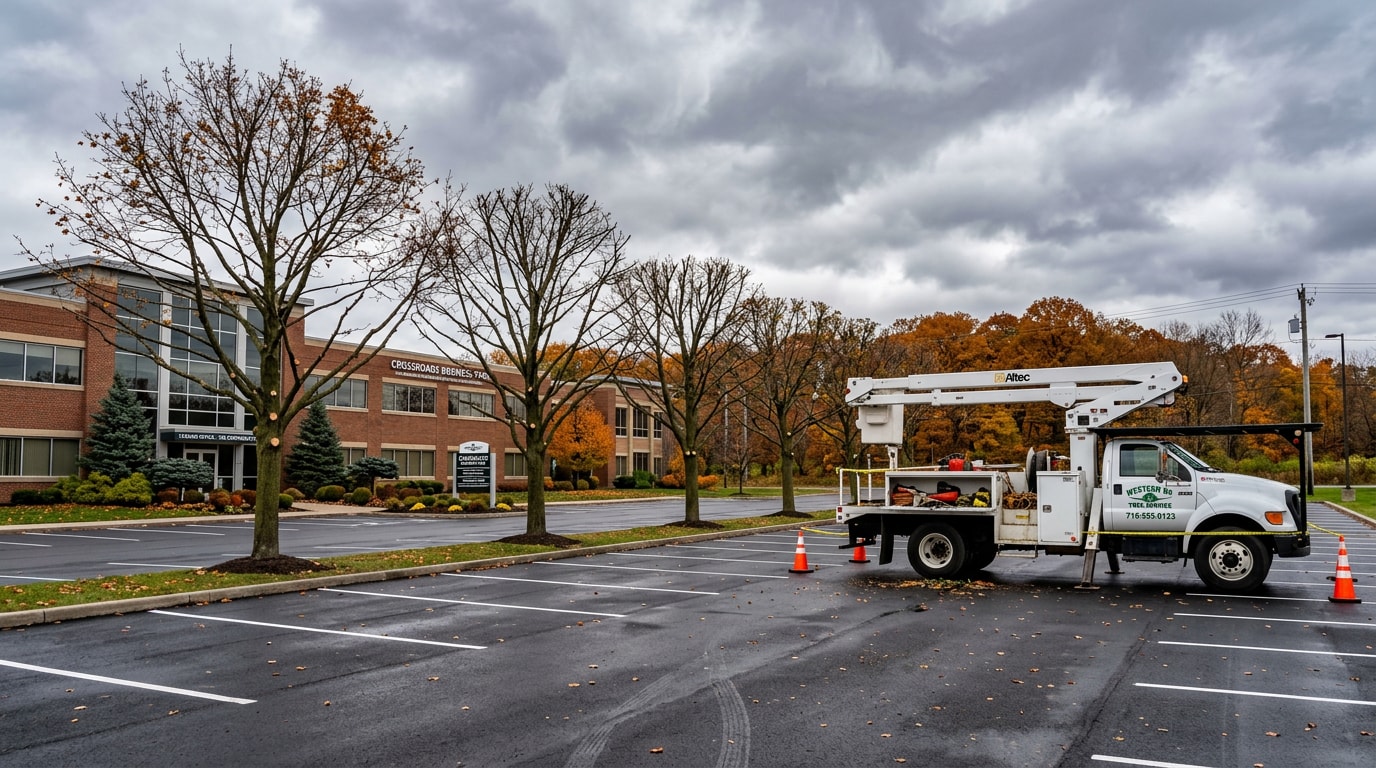
Commercial tree services are built for office parks, retail centers, industrial sites, HOAs, and multi-tenant properties, not single-family yards.
They typically involve:
- More trees per site visit, often across multiple lots or buildings
- Scheduling around business hours instead of a homeowner's weekend
- Documentation for insurance, ownership, and sometimes a municipality
- Coordination with tenants so parking lots and loading zones stay clear
Crews handling commercial sites in Orchard Park see a consistent pattern after a heavy, wet snowfall: silver maples and other fast-growing shade trees with weak branch unions split first, usually over parking areas or walkways where nobody expects it. That pattern is exactly why commercial accounts need a maintenance posture, not a one-call-at-a-time relationship.
What Services Does a Full-Service Commercial Tree Company Handle?
A full-service provider typically bundles several categories of work under one plan instead of treating each job as a separate call.
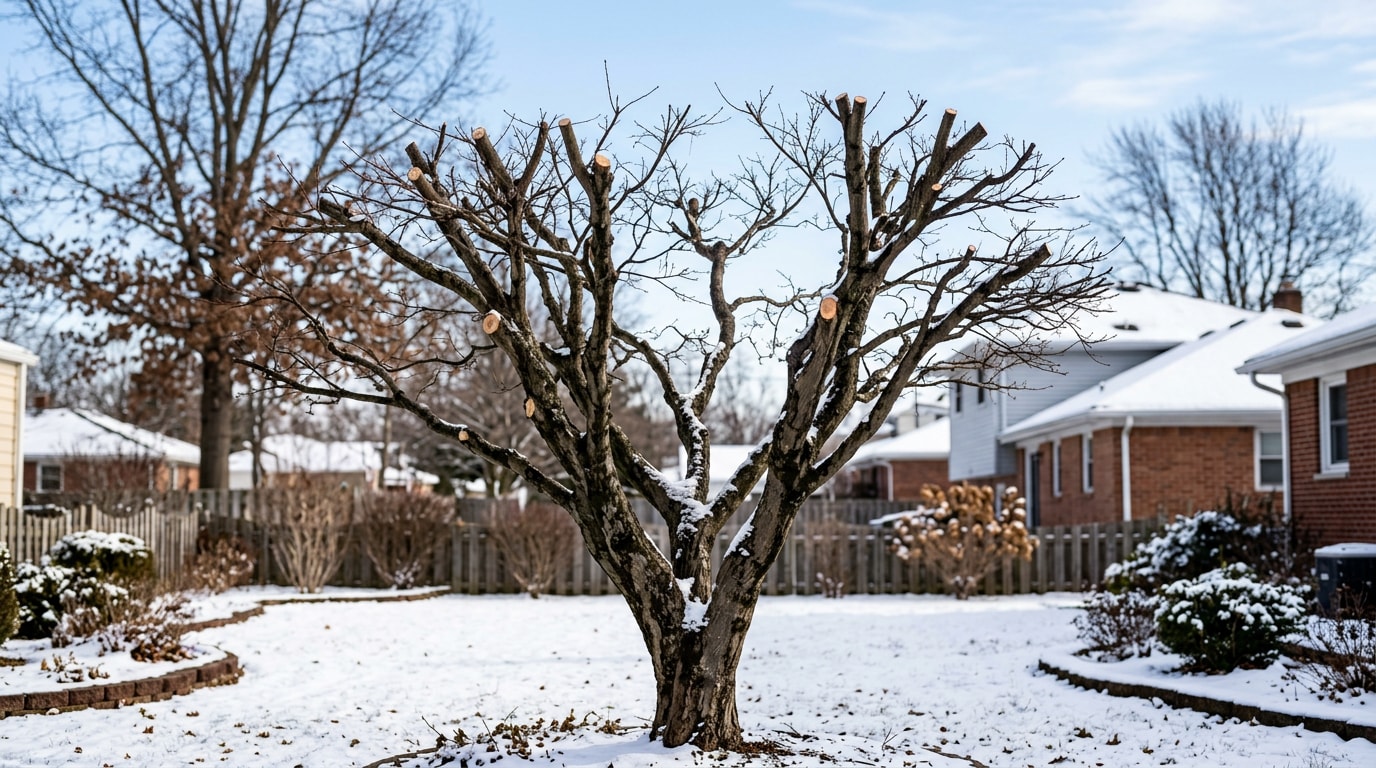
Tree pruning and structural work keeps canopies clear of rooflines, signage, and sightlines while reducing weak or overextended limbs before they fail. Tree pruning on a commercial schedule also protects long-term tree health better than reactive cuts after storm damage.
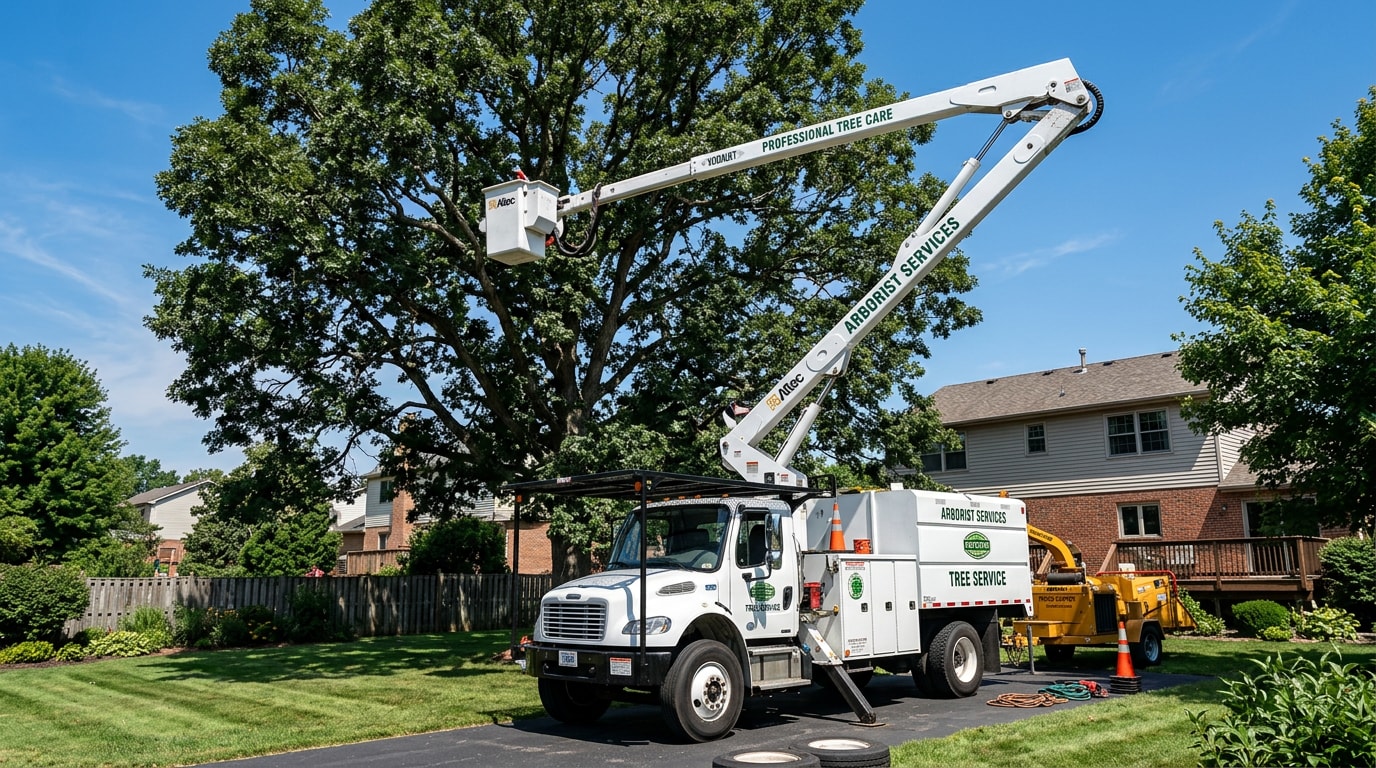
Removal and hazard mitigation addresses trees flagged during inspection as high-risk, whether from disease, root failure, or storm damage. Hazardous tree removal should always be handled by a crew with the right equipment for commercial-scale trees near buildings, power lines, or traffic.
Stump and site work often follows removal on commercial lots, especially during redevelopment or parking lot expansion. Stump removal and grinding and land clearing and site preparation frequently get bundled into the same contract for larger properties.
Emergency response rounds out the list. Storms don't wait for business hours, and a tree down on a roadway or roof needs a provider who answers the call immediately.
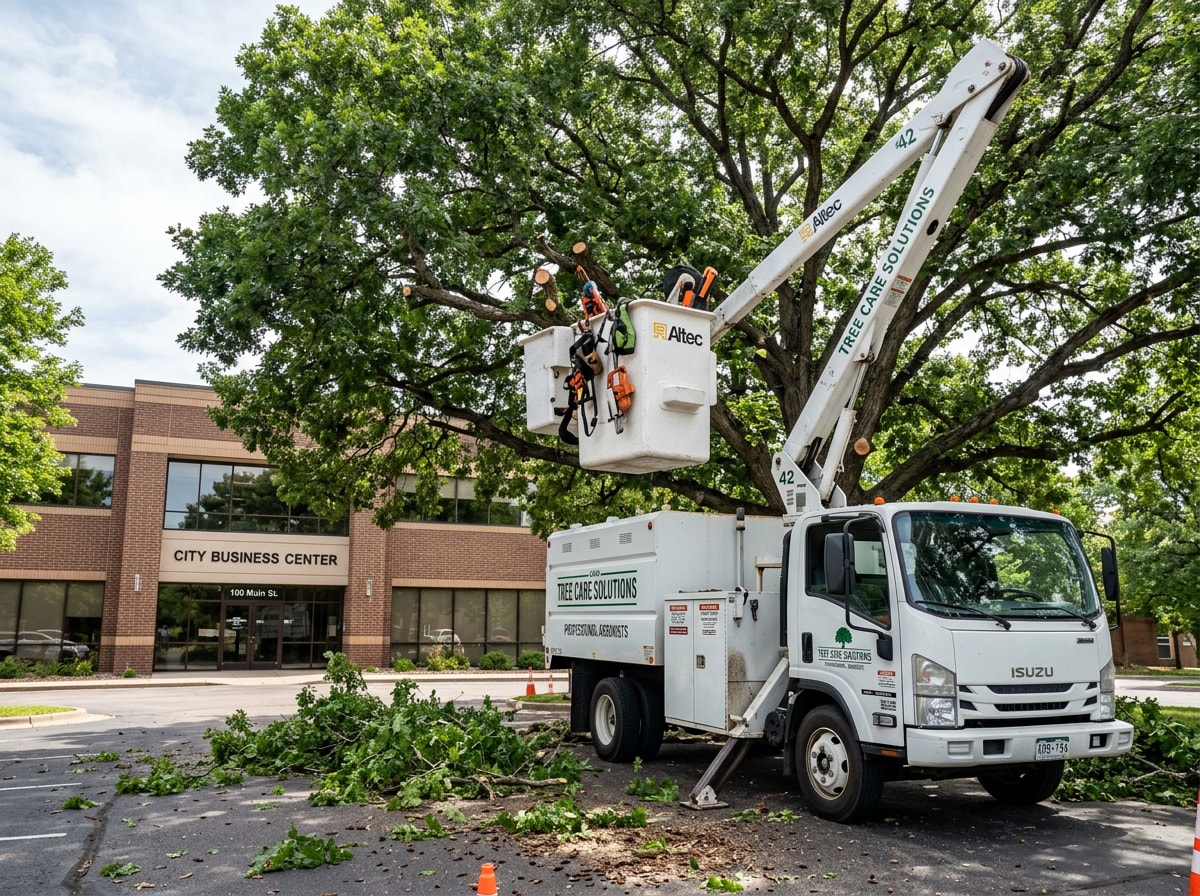
Commercial Tree Inspections: What Gets Checked and How Often
A commercial tree inspection checks trunk condition, branch structure, root stability, and deadwood so problems get caught before they become liability claims or emergency removals. Arborists look for cracks, cavities, fungal growth, soil heaving near the base, and any lean that has changed since the last visit.
Most commercial properties benefit from at least one full inspection per year, ideally in late winter or early spring before storm season ramps up. Larger properties, or sites with mature trees near buildings and parking, often warrant a second check mid-summer to catch storm damage or disease progression early.
Industry standards give this process structure instead of guesswork. The ANSI A300 Tree Care Standards have been developed by TCIA, an ANSI-accredited Standards Developing Organization, using procedures accredited by the American National Standards Institute.
These standards are approved by ANSI and are used as the final authority in the US civil court system, so compliance aligns a provider's work with the industry's highest benchmark. A provider worth hiring should be able to explain how their inspection process maps to that standard.
For a deeper look at what an inspection visit covers locally, see this tree assessment guide for Orchard Park, NY.
Why Scheduled Maintenance Beats Reactive Tree Care
Healthy, well-managed trees support curb appeal and property value. They also keep a site compliant with tree ordinance rules that many commercial properties overlook until a permit issue surfaces.
Commercial properties carry real liability for trees that fail or drop limbs over walkways, parking areas, or gathering spaces. Deferred maintenance rarely stays cheap. It just moves the bill to a worse time, usually after-hours, with cleanup and property damage added on top.
| Factor | Scheduled Maintenance | Reactive / Emergency Work |
|---|---|---|
| Timing | Planned around slow business periods | Unpredictable, often after-hours |
| Crew mobilization | Standard dispatch | Rush dispatch, higher demand |
| Debris and cleanup | Scoped in advance | Handled under time pressure |
| Property risk | Addressed before failure | Damage may already be done |
| Budget impact | Predictable line item | Draws from emergency reserve |
Western New York's lake-effect snow adds another layer of risk. Heavy, wet snow loads stress limbs that haven't been pruned in years, and a tree that looked fine in October can become a liability claim after the first major storm.
Beyond risk reduction, healthy canopy delivers a measurable site benefit. Urban trees can reduce stormwater runoff by absorbing 15 to 27% of annual rainfall, which matters on commercial lots where drainage and parking lot runoff are already a maintenance concern.
How to Vet a Commercial Tree Company in Orchard Park
Here's what separates a provider worth hiring from one that will cost you twice:
- Check credentials first.
The ISA Certified Arborist designation sets a provider apart as someone trained and knowledgeable in all aspects of arboriculture, and credential holders must adhere to a Code of Ethics. That's a stronger signal than years of experience with a chainsaw alone.
- Confirm insurance. An insured tree company protects your property if something goes wrong mid-job, from a dropped limb to equipment damage.
- Ask for commercial references. References from property managers, HOAs, or facility teams matter more than residential reviews, since commercial work involves different scheduling and liability.
- Get a written estimate. A scope, timeline, and pricing breakdown before work begins is a reasonable expectation, not an inconvenience. Vague quotes tend to produce vague results.
If you manage a property in Orchard Park and want a provider who checks all four boxes, request a free estimate before your next budget cycle locks in.
Building a Commercial Tree Maintenance Budget
A written plan beats ad hoc work every time. It should cover inspection frequency, pruning schedules by species, pest monitoring, storm prep, and a budget line for both routine and emergency work, plus an inventory of every tree on the property.
A useful budget separates three line items:
- Hazard mitigation — removal or correction of trees flagged as high or medium priority during inspection, the items that can't wait until next year's cycle.
- Routine maintenance — scheduled pruning, fertilization, and monitoring across the rest of the tree inventory.
- Emergency reserve — funding for after-hours calls and storm response, kept separate so one bad weather event doesn't blow up the annual budget.
Most property managers find it easier to defend this budget to ownership when it's broken into three categories instead of one lump sum.
Ready to put a maintenance plan in place? Visit our homepage to see the full range of commercial tree, stump, and land clearing services available across the region, or go straight to our contact page to schedule an inspection.
FAQ
What makes a commercial tree company different from a residential tree service?
Commercial providers handle more trees per visit, coordinate around tenants and business hours, and carry documentation and insurance scaled to larger liability. Many residential-only companies aren't equipped for that scheduling and scope.
How much does commercial tree service cost in Orchard Park, NY?
Cost depends on tree count, size, condition, and whether work is scheduled or emergency. Planned pruning and inspection visits cost far less than after-hours emergency removal once rush labor, cleanup, and potential property damage are factored in. For specific cost ranges on removal work, see this Orchard Park tree removal cost guide.
Do commercial properties in Orchard Park need a permit to remove a tree?
Many municipalities, including towns across Western New York, require a permit before removing certain trees on commercial or multi-tenant properties, often based on trunk diameter or zoning. Check with the local code enforcement office before removal rather than assuming a residential rule applies.
Can commercial tree service help prevent property damage?
Yes. Regular service catches weak limbs and deadwood before storms turn them into falling hazards. Proactive removal of deadwood ahead of a predicted snow or windstorm costs far less than repairing a roof, vehicle, or walkway after the fact.
Is tree removal part of standard commercial tree services?
Yes. Standard commercial tree services typically include trimming, pruning, removal, planting, emergency storm response, and ongoing maintenance. Hazardous tree removal specifically addresses trees flagged as high-risk before they become a liability.
Are commercial tree services environmentally friendly?
Most reputable providers lean toward eco-friendly practices where possible: selective pruning instead of removal when a tree can be saved, mulching or recycling debris on-site, and recommending native species for replacement planting. Healthy canopy also supports stormwater management, since trees can absorb 15 to 27% of annual rainfall that would otherwise run off paved commercial lots.